
The Ultimate Guide to How to Prepare for the Shift to Low GWP Refrigerants


The Ultimate Guide to How to Prepare for the Shift to Low GWP Refrigerants
Jun 26, 2026
Why Knowing How to Prepare for the Shift to Low GWP Refrigerants Matters for Polk County Homeowners
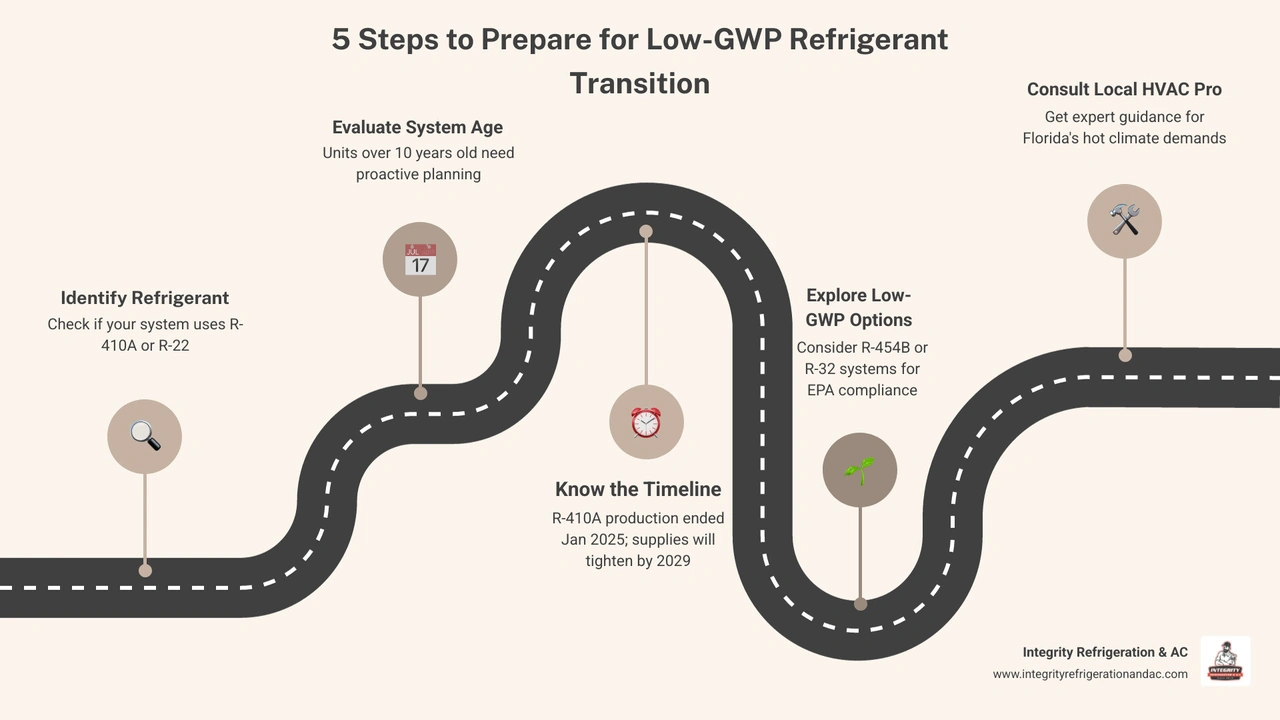
Preparing for the shift to low-GWP refrigerants starts with a few clear steps:
- Find out what refrigerant your current system uses (most Central Florida homes built before 2025 still run on R-410A or older R-22).
- Check your system's age and condition — units over 10 years old are prime candidates for proactive replacement.
- Understand the timeline — as of January 2025, manufacturers can no longer produce new HVAC equipment using R-410A, meaning servicing older systems will get harder and more expensive over time.
- Know your options — newer systems use low-GWP refrigerants like R-454B or R-32, which are more environmentally friendly and fully compliant with current EPA rules.
- Work with a qualified local HVAC professional who understands both the regulatory changes and your equipment needs in Florida's demanding climate.
If you've been hearing a lot about refrigerant changes lately and aren't sure what it means for your home or business, you're not alone. The HVAC industry is in the middle of one of its biggest shifts in decades — and it's being driven by federal law, not just market trends.
Under the EPA's American Innovation and Manufacturing (AIM) Act, the United States is phasing down the production and use of high-GWP (global warming potential) hydrofluorocarbon refrigerants by 85% before 2036. The steepest drop comes in 2029, when allowable production falls from 60% to just 30% of the historical baseline. That single step is expected to significantly tighten refrigerant supplies and push service costs higher for anyone still running older equipment like R-410A systems.
For homeowners and business owners in Polk County, FL, this isn't an abstract environmental policy — it has real, practical consequences. Florida's year-round heat means your cooling system works harder than almost anywhere else in the country. When refrigerant supplies tighten and older systems become harder to service, the stakes get even higher. Understanding the transition now, before it becomes an emergency, is the smart move.
I'm Billy Gregus, owner of Integrity Refrigeration & AC, and with nearly two decades of hands-on experience in both HVAC and refrigeration systems across Central Florida, I've been guiding homeowners and businesses through exactly this kind of industry shift — including helping clients understand how to prepare for the shift to low-GWP refrigerants before rising costs and tighter supply force their hand. Let's walk through everything you need to know so you can make confident, informed decisions for your property.
Understanding the Regulatory Drivers Behind the Refrigerant Transition
To successfully adapt to this industry-wide evolution, we must first understand the legal forces setting the timeline. The primary vehicle for change in the United States is the American Innovation and Manufacturing (AIM) Act, enacted by Congress to phase down hydrofluorocarbons (HFCs). HFCs have been the standard working fluids in air conditioning and commercial refrigeration for the past two decades. While safe for the ozone layer, they are incredibly potent greenhouse gases. For instance, R-410A has a global warming potential (GWP) of 2,088—meaning it traps over two thousand times more heat in the atmosphere than carbon dioxide over a 100-year timescale.
The AIM Act mandates a structured, step-down schedule to cut HFC production and consumption by 85% by 2036. The industry has already navigated the initial phases, but the next major milestone is a steep regulatory cliff. In 2029, production allowances will drop from 60% of the baseline down to just 30%. This 50% reduction in a single year will place immense pressure on the supply chain.
Historically, when similar phaseouts occurred, prices reacted sharply. During Europe’s F-Gas phasedown, R-410A prices spiked to between 2.4 and 11.7 times their baseline levels. We saw a similar dynamic in the U.S. with the R-22 phaseout, where prices rose up to 10-fold after production bans took effect.
Complementing the production caps is the EPA’s Technology Transitions Rule. This rule establishes strict GWP thresholds for new equipment. For example, residential and light commercial air conditioning and heat pump systems manufactured or installed after January 1, 2025, must utilize refrigerants with a GWP of 700 or less. Similar rules apply to variable refrigerant flow (VRF) systems starting in 2026, and cold storage or industrial applications by 2027.
While our focus remains strictly on our local service areas in Florida, it is worth noting that international policies, such as the EU F-Gas Regulation 2024/573, are pushing global manufacturers to develop ultra-low GWP platforms (often targeting a GWP under 150 by 2029 for split systems). Because the HVAC manufacturing sector is global, these international standards accelerate the research and development of the eco-friendly equipment we install locally today. Embracing these systems early is a great way to future-proof your home or business. You can read more about how upgrading can benefit your home in our guide on The Eco-Friendly Choice: Sustainable Cooling with AC Replacement.
A Homeowner's Guide on How to Prepare for the Shift to Low GWP Refrigerants
Proactive preparation is key to avoiding emergency replacement costs and system downtime when the Florida summer heat is at its peak. If you wait until your older R-410A system experiences a major leak or compressor failure in 2028 or 2029, you may face inflated repair costs due to skyrocketing refrigerant prices and limited parts availability.
By building a structured transition plan now, you can manage your home’s cooling assets strategically. A solid plan starts with a complete system inventory, noting the age, leak history, and refrigerant type of every unit on your property. This allows you to prioritize which systems need immediate attention and which ones can be safely maintained for a few more years. Keeping your current system in peak condition through regular tune-ups is essential to prevent leaks and maximize efficiency during this transitional period. Learn more about maintaining your system in our article on The Science Behind AC Tune-Up and Its Impact on Energy Saving.
Step 1: Assess Your Current System and Learn How to Prepare for the Shift to Low GWP Refrigerants
The very first step is identifying what is currently running inside your outdoor condenser and indoor evaporator coil. You can find this information on the manufacturer's data plate located on the side of your outdoor unit.
- R-22 (Freon): If your system was installed before 2010, it may run on R-22. Chemical production and import of R-22 ended entirely in 2020. Servicing these systems is incredibly expensive, and parts are becoming obsolete. If you have an R-22 system, a full replacement should be prioritized immediately.
- R-410A (Puron): This has been the standard for residential cooling since the mid-2000s. While new R-410A systems are no longer being manufactured, existing units can still be serviced using reclaimed gas. However, as the 2029 step-down approaches, the cost of R-410A will steadily rise.
- System Age and Useful Life: The average lifespan of an air conditioner in Central Florida’s humid, salty air is typically 10 to 15 years. If your R-410A system is already over 10 years old, investing in major repairs (like replacing a leaking coil) is often a poor financial decision compared to upgrading to a modern, low-GWP system.
- Leak History: Refrigerant leaks are the most common source of cooling failures. If your system has a history of repeated leaks, it is consuming more electricity and costing you money in constant refrigerant top-offs. Understanding this issue is critical; discover the details in our post on Understanding the Most Frequent Refrigeration Repair Issue.
Step 2: Plan Your Upgrade Path and How to Prepare for the Shift to Low GWP Refrigerants
Once you have assessed your system, you can map out your transition path. For most homeowners, this involves choosing between running your current R-410A system until it is no longer cost-effective to repair, or proactively replacing it with a next-generation system.
Because the new low-GWP refrigerants (such as R-454B and R-32) are classified as A2L (mildly flammable), they cannot be used as "drop-in" replacements in older systems designed for non-flammable A1 refrigerants like R-410A. The operating characteristics, safety controls, and electrical components are entirely different.
When planning your upgrade, you should evaluate:
- Energy Efficiency Gains: Modern low-GWP air conditioners and heat pumps feature advanced variable-speed compressors and high SEER2 (Seasonal Energy Efficiency Ratio) ratings. Upgrading an older, inefficient system can reduce your cooling energy consumption by 30% to 50%. These monthly utility savings help offset the capital cost of the replacement over time.
- Capital Planning: By planning your replacement proactively, you can budget for the upgrade rather than facing an unexpected emergency expense. We assist our customers by offering flexible financing options to make quality service affordable and accessible, ensuring comfort without financial strain.
- Safety and Code Compliance: New A2L systems feature advanced safety components, including integrated leak detection sensors and spark-proof electrical relays, ensuring your home remains safe and fully compliant with updated building codes.
To help you make the best decision, check out our guide on Energy Efficient Features to Look for in an AC Replacement.
Comparing Low-GWP Refrigerant Alternatives for Residential and Commercial Systems
As the industry transitions away from high-GWP HFCs, several alternatives have emerged as the frontrunners. These fluids are broadly categorized into synthetic HFO (hydrofluoroolefin) blends and natural refrigerants.
| Refrigerant | GWP | Safety Class | Primary Applications | Key Characteristics |
|---|---|---|---|---|
| R-410A (Legacy) | 2,088 | A1 (Non-Flammable) | Legacy Residential & Commercial AC | Being phased out; high GWP; rising service costs. |
| R-32 | 675 | A2L (Mildly Flammable) | Residential AC, Heat Pumps, Ductless Splits | Single-component gas; excellent efficiency; zero glide. |
| R-454B | 466 | A2L (Mildly Flammable) | Ducted Residential & Commercial AC | Zeotropic blend; closest match to R-410A pressures. |
| R-290 (Propane) | 3 | A3 (Highly Flammable) | Self-Contained Reach-In Coolers & Freezers | Natural refrigerant; limited to small charge sizes. |
| R-744 (CO2) | 1 | A1 (Non-Flammable) | Supermarket Transcritical Systems | High operating pressures; excellent in cold climates. |
| R-717 (Ammonia) | 0 | B2L (Toxic, Mild Flammability) | Industrial Cold Storage, Food Processing | Highly efficient; requires strict safety protocols. |
The transition introduces the A2L safety classification. Under the ASHRAE safety standard:
- Class A denotes low toxicity.
- Class 1 means no flame propagation.
- Class 2L indicates mild flammability with a slow burning velocity (less than 10 cm/s).
This means that while A2L refrigerants like R-32 and R-454B can ignite under very specific laboratory conditions with a high-energy ignition source, they are incredibly difficult to ignite in real-world settings and do not sustain a flame easily.
For residential and light commercial ducted systems, R-454B and R-32 are the dominant choices. R-32 is a single-component refrigerant, making it easy to recharge and recycle, and Daikin has installed over 280 million R-32 units worldwide since 2012. R-454B, a blend of R-32 and R-1234yf, has a lower GWP of 466 and operates at pressures very close to R-410A, making it the preferred choice for many major U.S. equipment manufacturers.
In commercial refrigeration, natural alternatives are leading the way. Propane (R-290) has excellent thermodynamic properties. Thanks to updated safety standards (such as EN IEC 60335-2-89:2022), the allowable charge limit for R-290 in self-contained commercial cases was raised from 150g to 500g, opening up the market for reach-in coolers and display cases. For larger commercial installations, exploring modern refrigeration design is highly beneficial; read more in Exploring Smart Solutions for Home Refrigeration Installation.
Retrofit vs. Full System Replacement: Making the Right Choice for Your Florida Property
When managing a building's cooling assets, a common question arises: Can we simply retrofit our existing systems with a new low-GWP refrigerant, or do we need to invest in a full system replacement?
In almost all residential and light commercial applications, retrofitting an R-410A system to use A2L refrigerants like R-454B or R-32 is not possible. Because A2L fluids are mildly flammable, building codes and safety standards (such as UL 60335-2-40) require systems using them to be certified and equipped with specific safety mitigation features. These include factory-installed leak detection sensors, spark-proof electrical contactors, and specialized ventilation controls. Attempting to drop an A2L refrigerant into a legacy R-410A system voids the manufacturer’s warranty, violates mechanical codes, and creates safety hazards.
For commercial refrigeration systems, retrofitting is sometimes viable when moving from older HFCs like R-404A to transitional HFC/HFO blends (like R-448A or R-449A). However, even these retrofits require careful engineering, including:
- Lubricant Compatibility: Ensuring the compressor oil (typically POE) is compatible with the new blend.
- Expansion Valve Calibration: Adjusting or replacing thermostatic expansion valves (TXVs) to account for differences in mass flow and temperature glide.
- Operating Pressures: Verifying that the system's structural components can handle the pressure curves of the replacement gas.
In the long run, a full system replacement is often the most cost-effective path. Upgrading older commercial rooftop units or refrigeration racks to native low-GWP systems reduces energy use by 30% to 50%. These operational savings can offset 20% to 40% of the capital replacement cost over the equipment's lifespan.
When planning upgrades for commercial assets, several critical factors must be evaluated. You can read about these in Key Factors to Consider Before Commercial Refrigeration Installation. If you are considering residential upgrades, you can also learn more about how modern systems save money in our article, Insights on How Heat Pumps Can Lower Your Energy Bills.
Frequently Asked Questions About the Low-GWP Refrigerant Transition
Can I still run and service my existing R-410A air conditioner?
Yes, absolutely. The EPA’s AIM Act restricts the manufacturing of new R-410A equipment, but it does not mandate the immediate retirement of existing systems. You can continue to run your R-410A system for the remainder of its natural operating life.
Servicing and repairs will rely on reclaimed and recycled R-410A. However, as the production of virgin HFCs is cut by 85% by 2036, the supply of R-410A will contract, and prices are expected to rise significantly. To maximize the lifespan of your current system and avoid costly leaks, proactive maintenance is essential. Be sure to read about the Top 5 Refrigeration Repair Mistakes to Avoid to keep your equipment running smoothly.
What makes A2L refrigerants different from traditional A1 refrigerants?
The main difference lies in their safety and flammability classifications. Traditional A1 refrigerants, like R-410A and R-134a, are classified as non-flammable. A2L refrigerants, such as R-32 and R-454B, are classified as mildly flammable.
Because of this, A2L systems require updated safety standards (including ASHRAE 15 and UL 60335-2-40 compliance). The systems are engineered with sealed electrical relays to eliminate spark sources, and they incorporate leak sensors that automatically activate the indoor blower fan to safely disperse the gas if a leak is detected. Handling these gases requires specialized tools, such as spark-free recovery machines and vacuum pumps rated for A2L use. For a deeper look at the technology driving these changes, read our article Behind the Scenes: The Technology of Modern Refrigeration Repair.
How do natural refrigerants like CO2 and propane perform in commercial settings?
Natural refrigerants perform exceptionally well and are considered "future-proof" because they have near-zero GWPs, exempting them from HFC phasedown quotas and bans.
- R-290 (Propane): Highly efficient in small-charge, self-contained systems like reach-in coolers and display cases. It offers excellent thermodynamic properties, often outperforming HFCs in energy efficiency.
- R-744 (Carbon Dioxide): Widely used in supermarket transcritical booster systems. CO2 has high operating pressures (up to 100 bar) and requires specialized steel piping and heavy-duty compressors, but it is highly efficient and environmentally friendly.
To learn more about how businesses are integrating these systems into their energy management strategies, read about Trends in Energy Management for Commercial Refrigeration Installation.
Conclusion
The transition to low-GWP refrigerants is one of the most significant environmental and technical shifts in the history of the HVAC industry. While navigating these changes can feel overwhelming, being proactive is the best way to protect your comfort and your wallet. By understanding the timeline, assessing your current equipment, and planning your upgrades before an emergency arises, you can ensure a seamless transition to eco-friendly cooling.
At Integrity Refrigeration & AC, we are proud to be your local "Climate Commanders." Based in Winter Haven, FL, and serving communities across Polk County—including Lakeland, Auburndale, Davenport, Bartow, and Haines City—we bring family-owned values and BBB A+ accredited expertise to every job. Our dual mastery of both residential/commercial HVAC and complex refrigeration systems uniquely positions us to guide you through this transition.
We offer 24/7 emergency service, transparent pricing with no hidden fees, and first-time fix reliability you can count on. Plus, with our flexible financing options and special promotions—including $500 off new installations—we make upgrading to a modern, energy-efficient system stress-free and affordable.
Don't wait for the 2029 regulatory step-down to drive up your maintenance costs. Schedule your low-GWP transition consultation with Integrity Refrigeration & AC today and let us help you plan a cool, efficient, and compliant path forward.
Recent Posts


backed by integrity guarantee
At Integrity Refrigeration and A/C, we believe that trust isn’t given, it’s earned