
The Dinner Rush Nightmare: Empty Ice Bins in a Sweltering Kitchen
If you are trying to figure out why your commercial ice machine production drops when the kitchen gets over 85 degrees, the answer usually comes down to basic thermodynamics rather than a broken compressor. It is 7 p.m. on a Friday, the dining room is packed, tickets are printing non-stop, and your staff is scrambling. But when a server goes to scoop ice for a tray of drinks, the bin is sitting half empty. The ice machine is running continuously, the fan is loud, and the water is flowing, but the actual harvest cycle seems to have slowed to a crawl. In our years of supporting Winter Haven local restaurants, our team at Integrity Refrigeration & A/C sees this frequent and frustrating scenario constantly, and we know firsthand how it directly impacts customer satisfaction and service speed.
When faced with an underperforming ice maker during peak service, kitchen managers are forced to make a rapid decision. Do you need to bring in floor fans to improve ventilation, crank down the dining room thermostat in hopes that cool air reaches the back of house, or start budgeting for a massive equipment upgrade? The reality we often explain to our clients is that commercial cooling equipment has physical limits. Air-cooled commercial ice machines lose their ability to reject heat efficiently once ambient temperatures cross a specific threshold. Understanding this threshold is the first step to restoring your kitchen's ice supply.
Before you assume the equipment is completely dead, it is crucial to evaluate the environment it operates in. Fixing the issue often starts with an assessment of your commercial refrigeration and HVAC services, ensuring that the entire building's airflow is working together rather than fighting against your ice production.
The Thermodynamics of Heat Rejection: Why 85 Degrees Breaks the Cycle
To understand why an ice machine struggles in a hot kitchen, our technicians always start by explaining how refrigeration actually works. An ice machine does not simply "make cold"; it removes heat from water until that water freezes. This heat has to go somewhere, and in an air-cooled system, it is expelled into the surrounding ambient air through the condenser coil. This process relies entirely on a thermodynamic principle known as Delta-T (the temperature differential).
When the air in your kitchen is cool, the hot refrigerant inside the condenser coil can easily transfer its heat into the room. However, when the ambient temperature climbs, that temperature gap shrinks. Once the surrounding air reaches 85+ degrees ambient temperature, the condenser struggles to shed heat. The refrigerant cannot condense back into a liquid efficiently, which drastically slows down the freezing cycle on the evaporator plate. If the heat cannot escape, the ice cannot form.
Industry testing standards highlight just how severe this drop-off can be. The Air-Conditioning, Heating, and Refrigeration Institute (AHRI) rates commercial ice-makers based on a baseline of 90-degree ambient air and 70-degree incoming water to determine true capacity under a heavy load. However, the optimal design envelope for peak efficiency is usually 70-degree air and 50-degree water. When your kitchen drifts away from that optimal zone, the math becomes unforgiving. We routinely see ice production plummet by 20% to 30% or more as ambient heat approaches and exceeds 90 degrees.
It is incredibly common for kitchen staff to assume the unit is failing, prompting calls for emergency repair services. While professional intervention is often necessary to diagnose the airflow, the machine itself isn't necessarily broken. It is simply operating outside its intended design envelope, suffocating in an environment that prevents proper heat transfer.

Understanding Delta-T in Commercial Refrigeration
Delta-T is the critical temperature gap between the hot refrigerant gas inside the condenser coils and the air blowing across those coils. Think of the ambient air like a sponge. A dry sponge (cool air) can easily soak up water (heat). But if the sponge is already saturated (hot air), it cannot absorb much more. When the shrinking temperature gap prevents the refrigerant from shedding its thermal load, the entire mechanical cycle stalls. The compressor runs longer and harder, consuming more electricity, while producing a fraction of the normal ice yield.
How High Humidity and Makeup Air Compound the Problem
While basic ambient heat is a major hurdle, the specific regional climate reality of a Central Florida summer introduces a secondary, highly destructive element: extreme humidity. Commercial kitchens are complex ecosystems of airflow. Exhaust hoods pull massive volumes of hot, grease-laden air out of the building. To prevent the building from depressurizing, makeup air systems pull fresh exterior air back inside. If that makeup air is not properly conditioned, you are essentially pumping the outside climate directly into your kitchen.
As we navigate the peak summer heat of July 2026, with Winter Haven's average high hovering around 93 degrees and pushing 90% humidity, unconditioned makeup air instantly creates a hostile environment for any air-cooled equipment. When this humid air is drawn into the building, it spikes the ambient temperature directly around the ice machine. But more importantly, it introduces a massive latent heat load. Latent heat refers to the energy required to deal with moisture in the air. When the air is thick with humidity, the equipment is forced to work substantially harder to reject heat, further straining the air-cooled condenser.
During these peak summer months, our team frequently responds to calls where a kitchen has easily exceeded 95 degrees because the air balancing is off. When makeup air blows directly toward the ice machine's intake louvers, the condenser is forced to breathe in 90-degree, moisture-heavy air. The moisture can also cause condensation on surrounding surfaces, which attracts dust and airborne flour, quickly forming an insulating blanket of grime over the condenser fins. This compounding effect accelerates the loss of heat transfer, turning a minor drop in ice production into a complete system stall.
Honest Diagnostics: Is the Ice Machine Broken, or Just Suffocating?
When the ice bin is low, the immediate reaction is often fear of a catastrophic mechanical failure. There is a common misconception that a sudden drop in ice production automatically means a dead compressor, a failed expansion valve, or a severe refrigerant leak. While these issues certainly happen, jumping to the worst-case scenario can lead to expensive and unnecessary parts swapping when the root cause is actually poor kitchen ventilation or blocked clearances.
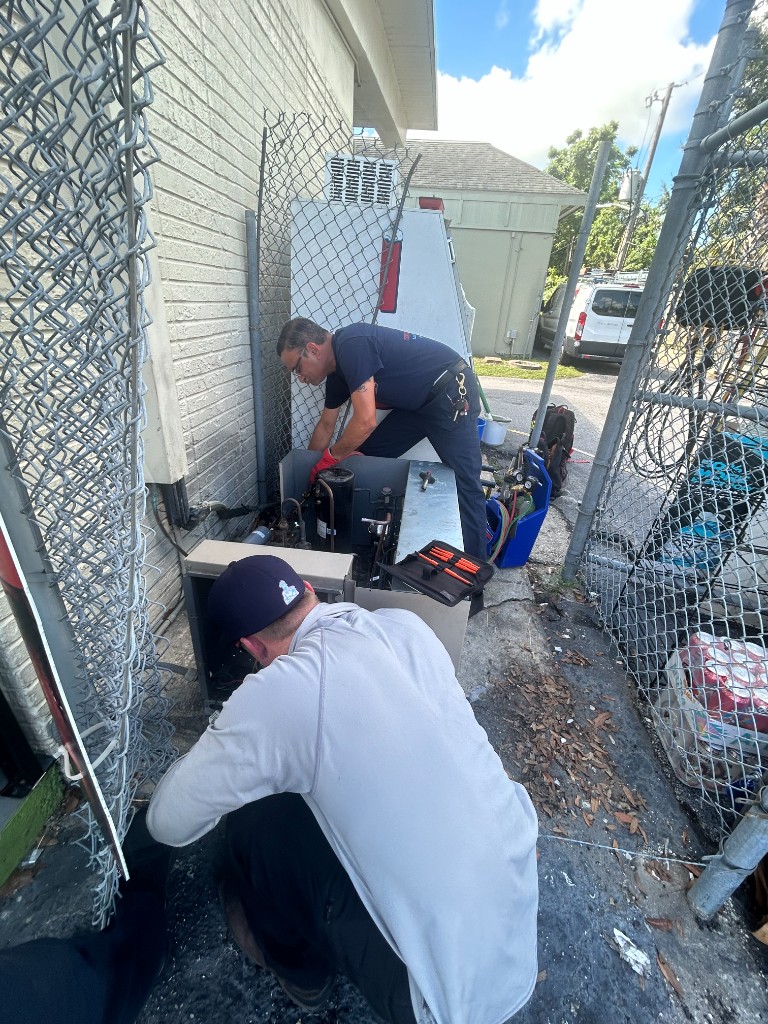
A frequent diagnostic pattern our technicians see in Winter Haven local restaurants involves heavily stressed units that are saved through environmental corrections rather than full replacement. During a recent severe heat wave, a local business reached out to us because their cooling equipment stopped working entirely in the Florida heat. One of our technicians arrived within 30 minutes, diagnosed the core airflow issue, and made immediate adjustments, getting the unit up and running quickly without unnecessary replacements. This highlights the danger of treating the symptom rather than the disease.
At Integrity Refrigeration & A/C, our commitment to honest diagnostics means finding the root environmental cause to save owners from buying new equipment unnecessarily. A thorough diagnostic process must evaluate the ambient air intake, the cleanliness of the condenser coil, and the proximity of surrounding heat sources like fryers, ovens, or dishwashers before ever condemning the unit.
| Symptom | Likely Environmental Cause (Suffocation) | Likely Mechanical Cause (Failure) |
|---|---|---|
| Long harvest cycles | Ambient air above 85 degrees; blocked louvers | Failing water inlet valve; low refrigerant |
| Thin or hollow ice cubes | High incoming water temperature (above 70 degrees) | Clogged water distribution tube; scale buildup |
| Unit running constantly but warm to touch | Grease-packed condenser coil preventing heat transfer | Weak compressor valves; failing condenser fan motor |
Immediate Triage Steps to Restore Ice Production
When our commercial clients call us mid-shift with dropping ice production as the kitchen heats up, we always recommend a few immediate, practical solutions their staff can implement. While you cannot change the weather, you can often improve the micro-climate directly surrounding the machine to help it survive the shift.
- Clear the breathing room: Ensure boxes of produce, dry goods, and cleaning supplies are not stacked against the ice machine. Air-cooled units require specific clearances (often 6 to 12 inches on the sides and back) to allow hot exhaust air to escape. If the exhaust louvers are blocked, the machine will simply recycle its own hot air.
- Check and clean the air filters: Most commercial units have a washable, reusable air filter positioned over the condenser coil. If this is caked in dust or grease, remove it and wash it out. However, if the actual metal condenser fins behind the filter are packed with deep grease buildup, schedule a professional cleaning to avoid bending or damaging the delicate fins.
- Evaluate the kitchen's AC balance: Look at the supply registers on your ceiling. Ensure that cool air is being properly directed toward the prep areas and the ice machine without blowing so hard that it creates condensation issues. Proper air balancing helps dilute the 85+ degrees ambient temperature pockets that form in corners.
- Listen for mechanical strain: Pay attention to the operational sounds of the unit. If you hear a grinding fan motor or notice a struggling compressor, it might indicate the system is fighting against severe head pressure. Understanding why your AC is making hissing sounds or why your ice maker is rattling can help you communicate the exact symptoms to our dispatchers.
Optimizing Kitchen Airflow
Beyond the machine itself, check your kitchen exhaust hoods. Ensure they are operating at the correct speed and that grease baffles are clean so they can effectively remove heat from the cookline. Simultaneously, verify that any makeup air registers are not blowing unconditioned, humid exterior air directly onto the ice machine's condenser. Redirecting a single vent can sometimes drop the ambient temperature around the machine by several degrees, restoring a functional Delta-T.
Long-Term Solutions for High-Heat Kitchens
If your kitchen physically cannot maintain temperatures below 85 degrees during the Central Florida summer, environmental triage will only get you so far. High-volume restaurants often require permanent structural or equipment upgrades to separate the heat-rejecting components from the hot cookline environment.
One of the most effective long-term solutions our team recommends is relocating the ice machine to a dedicated, climate-controlled prep room or a well-ventilated back hallway. Moving the machine away from the fryers and ovens instantly improves its operating efficiency. However, if space is at a premium and relocation is impossible, upgrading the equipment design is the next logical step.
Water-cooled condensers are an alternative that use incoming water to absorb and carry away heat, completely bypassing the need for cool ambient air. While highly effective in hot kitchens, they consume massive amounts of water, which can lead to staggering utility bills. Many municipalities also have strict regulations or outright bans on single-pass water-cooled systems due to conservation efforts.
Because of this, we often suggest remote-condenser ice machines as the most efficient long-term investment. By moving the heat-rejecting component outside, you solve the ambient temperature problem permanently. To keep any system running efficiently, it is vital to schedule routine equipment inspections before the peak season hits, ensuring coils are clean and refrigerant charges are precise.
Upgrading to a Remote Condenser
A remote condenser system splits the ice machine into two parts. The ice-making evaporator and water bin stay in the kitchen, while the condenser coil and fan are mounted on the roof, similar to a standard commercial AC unit. Refrigerant lines connect the two. This setup completely removes the heat load from the kitchen interior. Furthermore, because the condenser is outdoors, it benefits from better airflow and does not have to fight against the grease-laden air generated by the cookline. For high-volume operations in hot climates, this upgrade frequently pays for itself through increased ice yields and reduced strain on the kitchen's primary air conditioning system.
Frequently Asked Questions About Commercial Ice Machines in Hot Climates
What temperature is too hot for a commercial ice machine?
Once the ambient air temperature exceeds 85 degrees, an air-cooled commercial ice machine begins to lose efficiency rapidly. At 90 degrees and above, production can drop by 20% to 30%, and the machine will struggle to form solid ice. For optimal performance, manufacturers recommend keeping the surrounding air temperature as close to 70 degrees as possible.
Why is my commercial ice machine making less ice?
A drop in ice production is most commonly caused by poor heat rejection due to high ambient kitchen temperatures, restricted airflow, or a dirty condenser coil. When the machine cannot dump heat into the surrounding air, the freezing cycle slows down significantly. Other factors include high incoming water temperatures or scale buildup on the evaporator plate, which acts as an insulator.
How does ambient temperature affect ice production?
Ambient temperature directly dictates the efficiency of the refrigeration cycle through a principle called Delta-T. The condenser needs cool surrounding air to absorb the heat pulled from the water. If the ambient air is hot, the temperature gap shrinks, heat transfer stalls, and the compressor has to run much longer to freeze a single batch of ice.
How do you cool down a commercial ice machine?
To cool down a struggling machine, start by clearing at least 6 to 12 inches of space around its intake and exhaust louvers to ensure proper airflow. Clean the reusable air filter to remove dust and grease. Finally, check your kitchen's air conditioning registers to ensure cold supply air is reaching the machine's location without blowing directly on it and causing condensation.
Why does ice production drop in the summer?
Summer brings extreme heat and high humidity, both of which are drawn into commercial kitchens through makeup air systems and open doors. This unconditioned air heavily increases the ambient temperature and the latent heat load around the machine. The equipment is forced to work harder to reject heat into an already saturated, hot environment, leading to longer harvest cycles.
At what ambient temperature does an air-cooled ice machine stop working efficiently?
An air-cooled ice machine generally stops working efficiently when the ambient air hits the 85+ degrees ambient temperature threshold. While the machine will still technically run, the production rate will drop drastically, and the ice cubes may become thin or hollow. Prolonged operation in temperatures above 95 degrees can eventually lead to compressor failure due to excessive head pressure.
Get Professional Help Balancing Your Kitchen's Cooling Load
Restoring your ice production often requires a holistic look at the entire kitchen's environment, not just the machine itself. When the ambient temperature climbs, the physics of heat rejection simply stop working in your favor. Having a scientific, honest explanation of why ambient heat kills ice production empowers kitchen managers to make the right call—whether that is clearing blocked louvers, redirecting an AC vent, or planning an equipment upgrade.
If your Winter Haven local restaurant is constantly running out of ice during the dinner rush, do not immediately assume you need to buy a brand-new machine. We encourage you to seek professional diagnostics from the team at Integrity Refrigeration & A/C to evaluate your ventilation, AC performance, and refrigeration health together. By addressing the root environmental causes, you can restore your ice yield, protect your equipment, and keep your kitchen running smoothly through the hottest months of the year.