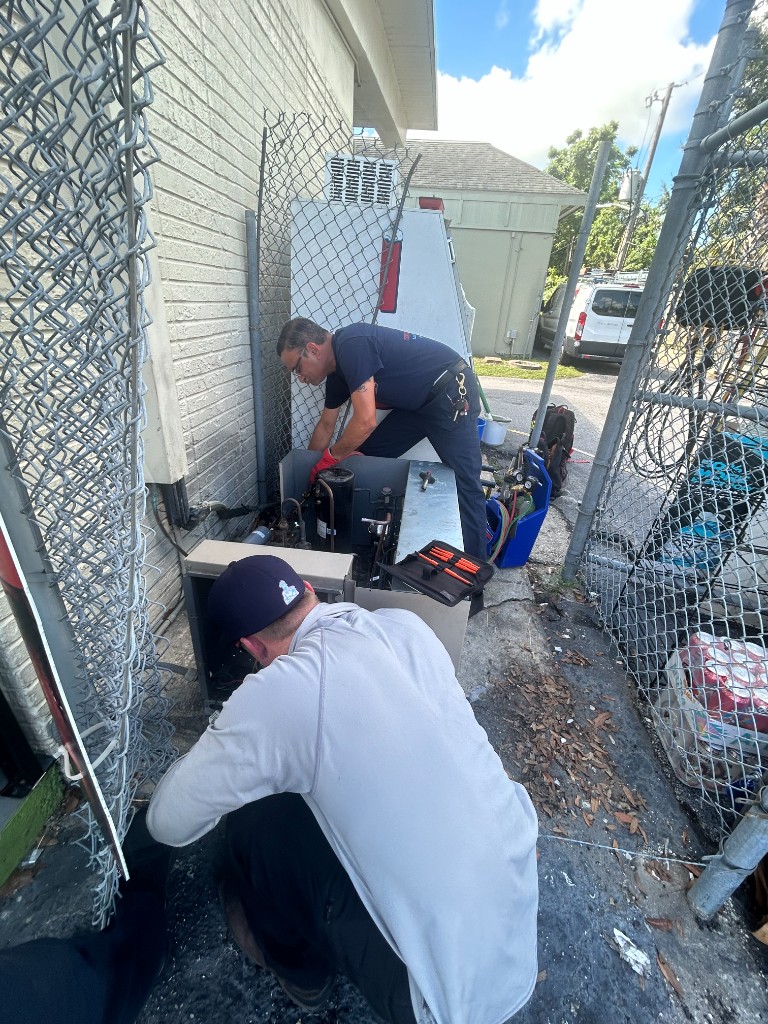

The Hidden Threat of September's 'False Fall' to Commercial Walk-Ins
Before the end of summer officially arrives, transitioning your commercial refrigeration settings for Florida's False Fall is the only way to prevent sudden, catastrophic ice buildup in your walk-in coolers. Year after year, our team at Integrity Refrigeration & AC sees the exact same pattern: September in Central Florida brings a very specific weather pattern where daytime temperatures often linger in the high 90s, but evening temperatures suddenly begin to drop. While this shift feels like a welcome relief outside, it creates a volatile environment inside your commercial kitchen. The lingering daytime heat combined with sudden evening cooling triggers extreme condensation and massive humidity swings.
When warm, moisture-heavy air enters a walk-in cooler that is still running on aggressive summer settings, that moisture rapidly condenses and freezes on the evaporator coils. In our experience, leaving your equipment on a static summer schedule is a guaranteed recipe for a system freeze-up. To protect your perishable inventory, you need proactive commercial cooling and air conditioning services to recalibrate your system for the changing season. Preparing for September 'False Fall' humidity swings requires technical precision, not just a basic filter change.
Why Static Summer Defrost Settings Fail During Seasonal Transitions
Commercial walk-in coolers are finely tuned machines designed to operate in a delicate balance. During peak summer, defrost timers are calibrated for consistent, high-heat, high-humidity loads. The system expects the compressor to run almost constantly, and the defrost cycles are spaced out to handle that specific thermal load. However, when we dispatch crews to Winter Haven restaurants during this seasonal shift, the most common culprit we find for sudden freeze-ups is a static summer schedule that has become a liability.
As evening temperatures drop during the seasonal transition, the ambient heat load on the cooler box decreases. The compressor doesn't need to run as long to maintain the target temperature. But because humidity frequently remains above 75%, every time the cooler door opens, massive amounts of moisture still enter the box. Because the compressor is running less, the static summer defrost cycle—which is often time-initiated and time-terminated—fails to clear the heavy frost load that accumulates from the trapped moisture. The cycle is either too short or doesn't happen frequently enough to handle the unique demands of Winter Haven commercial kitchens during this transition.
The limitations of static schedules:
- Time-Initiated Cycles: A timer tells the system to defrost every fixed number of hours, regardless of how much ice is actually on the coil.
- Temperature-Terminated Failsafes: If the termination thermostat isn't adjusted for cooler ambient nights, the heater may shut off before the coil is fully clear of ice.
- Moisture Trapping: High humidity combined with shorter cooling cycles means moisture stays in the air longer, eventually turning to frost.
At Integrity Refrigeration & AC, our specialized local knowledge of Winter Haven's unique climate fluctuations allows us to anticipate these exact failures. We know firsthand that basic fall maintenance is not enough. You need dynamic defrost timer recalibration. The complexities of calibrating supermarket refrigeration systems and restaurant walk-ins demand a deep understanding of how varying external loads interact with mechanical defrost components.
The Impact of Rapid Humidity Shifts on Evaporator Coils
Walk-in coolers typically operate between 35°F and 38°F. At these temperatures, the evaporator coil itself is running well below freezing to absorb heat from the air. When the September 'False Fall' humidity swings push warm, wet air across those sub-freezing coils, the moisture instantly turns into frost.
If the defrost cycle is too short for the transitional weather, a thin layer of frost remains when the cooling cycle restarts. This thin layer acts as an insulator. The coil can no longer absorb heat efficiently, forcing the system to run longer. The longer it runs, the more ice builds up, creating a rapid snowball effect that ends in a completely encased evaporator coil.

Recognizing the Early Warning Signs of Defrost Failure
Our lead technicians always advise facility managers and kitchen staff to stay vigilant during the early days of autumn. Catching a failing defrost cycle early can mean the difference between a quick adjustment and a total loss of product. Because September 'False Fall' humidity swings happen rapidly, the symptoms of equipment strain will appear just as fast. You do not want to wait until the cooler is completely warm to take action.
Watch for these critical early warning signs:
- Light frost on the evaporator fins: Before a solid block of ice forms, you will notice a white, powdery frost accumulating on the aluminum fins or near the fan guards. This is the first indicator that the defrost cycle is terminating too early.
- Erratic temperature fluctuations: If your cooler is set to 35°F but frequently climbs to 42°F before slowly struggling back down, the system is losing its cooling capacity due to restricted airflow.
- Changes in fan noise: As ice builds up behind the fan blades, the air restriction causes the fan motors to sound louder, higher-pitched, or strained. You may also hear a distinct rattling if ice physically touches the spinning blades.
- Excessive condensation on walls or ceilings: If the evaporator cannot remove moisture from the air efficiently, that moisture will settle and pool on the interior surfaces of the walk-in box.
- Compressor running continuously: If you never hear the system cycle off, the compressor is working overtime to push air through partially frozen coils.
One local facility manager recently experienced the frustration of complex equipment failure during a sudden cold snap when a brand-new unit stopped working entirely. After other companies could not resolve the issue, our technicians worked for days to diagnose the intricate control problem and completely fix the unit. That same level of rigorous, professional system inspection and testing is required when your walk-in cooler starts showing signs of erratic defrost behavior during the fall transition. Do not ignore the early warnings.
The High Cost of Ignoring Seasonal Recalibration
Allowing a commercial walk-in cooler to operate with improper defrost settings is a massive financial risk. The most immediate impact is on your utility bills. When an evaporator coil is even partially frozen, it loses its ability to transfer heat. To compensate, the compressor must run significantly longer to achieve the same cooling effect. This forced overexertion leads to a noticeable increase in energy consumption. For Winter Haven commercial kitchens operating on tight margins, that wasted electricity quickly eats into profitability.
Beyond the monthly utility costs, the risk of catastrophic inventory spoilage is severe. We have seen too many local businesses lose entire shipments of perishable food because they delayed a simple seasonal tune-up. A partially frozen coil can turn into a solid block of ice overnight. Once the coil is completely encased, airflow stops entirely. The ambient temperature inside the box will rapidly climb into the danger zone, ruining massive amounts of dairy, proteins, and produce before the morning prep shift even arrives.
Furthermore, ignoring seasonal recalibration causes severe long-term wear and tear on your equipment. When a compressor runs continuously to overcome an iced-up coil, it runs hot. This degrades the compressor oil and puts immense stress on the electrical components. Over time, this drastically shortens the lifespan of the refrigeration unit, turning what should have been a simple seasonal adjustment into a premature system replacement. Positioning routine commercial refrigeration maintenance as an investment in inventory protection is the smartest move a business owner can make.
Why Defrost Timer Adjustments Are Not a DIY Project
With the high stakes of commercial inventory on the line, it can be tempting to try and adjust the defrost timer yourself to force the ice to melt. We frequently field emergency calls where a well-meaning staff member tried to tweak these settings, which is a dangerous mistake. Commercial refrigeration controls are highly complex, and balancing the duration, frequency, and termination temperatures of a defrost cycle requires specialized training and specialized tools.
A typical commercial defrost timer features multiple settings that must work in harmony. If an untrained individual adjusts the timer pins incorrectly, they risk trapping the system in a perpetual defrost cycle. When this happens, the defrost heaters stay on indefinitely, effectively turning your walk-in cooler into an oven and ruining all the food inside. Conversely, if the defrost cycle is shortened too much, the system will never clear the accumulated frost, resulting in a solid block of ice that completely halts cooling.
The risks of unlicensed adjustments:
- Electrical Hazards: Commercial walk-ins operate on high-voltage circuits. Accessing the timer mechanisms exposes you to dangerous live wires.
- Sensor Damage: The termination thermostat and defrost limit switches are delicate. Improper handling can permanently break the sensors that tell the system when the ice is gone.
- Voided Warranties: Most commercial equipment manufacturers will immediately void the warranty if unlicensed personnel modify the electrical and refrigeration controls.
- Refrigerant Floodback: Incorrect defrost settings can cause liquid refrigerant to return to the compressor, causing catastrophic mechanical failure.
Navigating September 'False Fall' humidity swings requires a licensed professional who can measure the exact amperage of the defrost heaters, test the resistance of the temperature sensors, and verify the timer's mechanical operation. Avoiding DIY mistakes is the easiest way to prevent the need for costly emergency repair services down the line.
Frequently Asked Questions About False Fall Refrigeration Care
Why is ice building up on my walk-in cooler evaporator coil in September?
Ice builds up in September because static summer defrost settings fail to account for fluctuating autumn weather. While evening temperatures drop, the humidity often remains high, creating extreme condensation inside the box. If the defrost cycle isn't recalibrated for these specific conditions, the moisture freezes on the coil faster than the system can melt it off.
How often should commercial refrigeration be serviced in Florida?
In our daily service routes across Florida, we recommend commercial refrigeration systems be professionally serviced at least four times a year, ideally aligning with major seasonal shifts. Winter Haven commercial kitchens experience extreme heat and humidity, which places relentless stress on compressors and coils. Routine quarterly maintenance ensures that defrost timers, refrigerant levels, and electrical components are always calibrated for the current weather pattern.
What temperature should a commercial walk-in cooler be set at during the fall?
A commercial walk-in cooler should consistently be maintained between 35°F and 38°F, regardless of the season outside. The internal set point does not change in the fall; rather, it is the defrost schedule and operational cycles that must be adjusted. Maintaining this strict temperature range is critical for food safety and preventing premature spoilage.
How do you adjust a defrost timer on a commercial freezer?
Adjusting a commercial defrost timer requires a licensed refrigeration technician, as it involves balancing high-voltage electrical components, time-initiated pins, and temperature-termination sensors. Attempting to adjust these settings yourself can result in severe electrical shock, perpetual defrost cycles that ruin food, or solid ice blocks that destroy the compressor. Always call a professional to recalibrate commercial controls.
Can humidity cause a walk-in cooler to freeze up?
Yes, excessive humidity is one of the primary causes of evaporator coil freeze-ups. Every time the cooler door is opened, warm, moisture-laden air rushes inside and condenses on the sub-freezing evaporator fins. If the defrost cycle isn't long enough or frequent enough to clear this heavy moisture load, it quickly turns into solid ice.
What is the difference between a summer and fall defrost cycle?
A summer defrost cycle is typically designed for a system that runs almost continuously under high ambient heat, requiring frequent, aggressive defrosting. A fall defrost cycle must account for cooler ambient nights where the compressor runs less frequently, but humidity remains high. The fall cycle must be dynamically adjusted to ensure ice is cleared without unnecessarily heating the box during shorter cooling runs.
Protect Your Commercial Inventory Before the Next Humidity Spike
Leaving your static summer settings active during the unpredictable September transition is a massive risk to your business operations. The rapid humidity swings and dropping evening temperatures create the perfect storm for evaporator coil freeze-ups, leading to wasted energy, strained compressors, and the devastating loss of perishable inventory. You cannot afford to wait until your cooler is blowing warm air to take action.
There is profound peace of mind that comes from knowing your inventory is fully protected against sudden weather shifts. At Integrity Refrigeration & AC, we want to help you avoid that late-night emergency call. By acting now, you ensure your equipment operates efficiently and reliably through the changing season. Schedule your professional recalibration and routine commercial refrigeration maintenance today to protect your equipment from the September 'False Fall' humidity swings before a catastrophic freeze-up occurs.