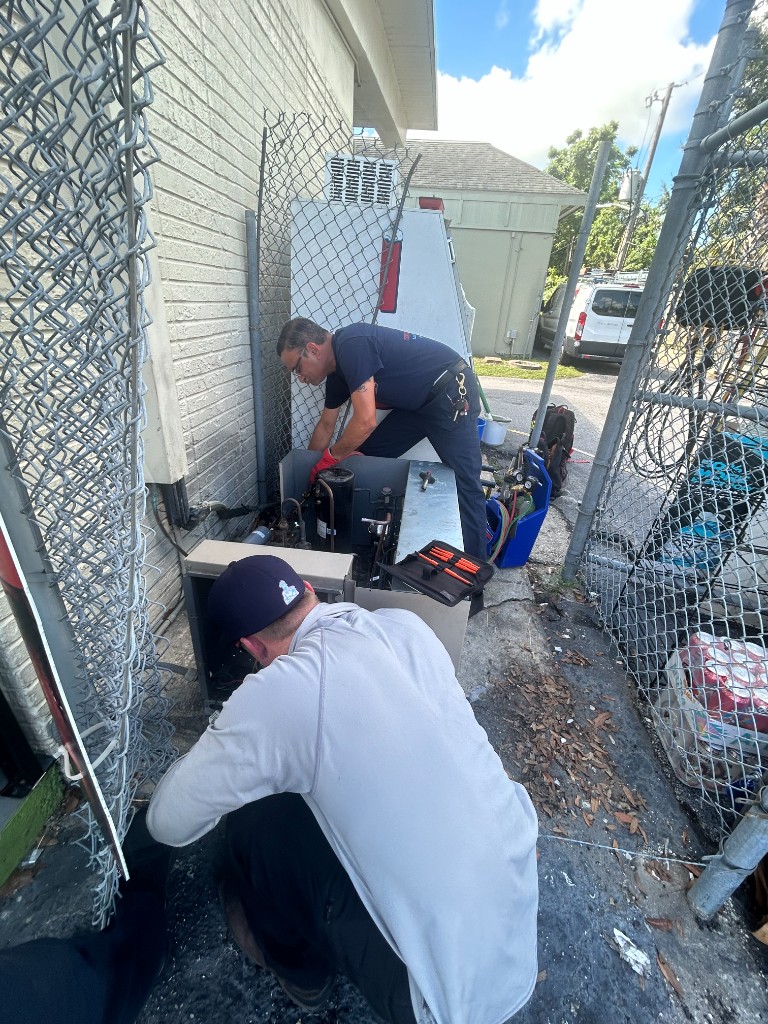

The Breaking Point: When Supermarket Cases Sweat in Late Summer
If you manage a facility in Central Florida, especially as the late-summer back-to-school rush brings heavier foot traffic through your automatic doors, understanding how we calibrate supermarket refrigeration systems to handle Florida's August humidity is often the difference between a safe, dry aisle and a dangerous puddle on the floor. Your air conditioning is running continuously, yet the glass doors on your frozen food aisles are fogged over, and condensation is dripping onto the tile. In our years of servicing commercial HVAC systems across Central Florida, our team at Integrity Refrigeration & AC has seen this concrete problem plague facility managers every late summer when extreme outdoor moisture penetrates indoor environments. It creates immediate, high-stakes consequences: slip-and-fall hazards for your customers, overworked compressors struggling to keep up, and compromised food safety that can easily trigger a health inspector's concern.
Standard maintenance routines—like wiping down gaskets or changing air filters—simply aren't enough when you are battling the peak subtropical climate. To resolve these complex environmental challenges, your facility requires specialized intervention. If you are looking for comprehensive Air Conditioning & Cooling Solutions, our approach at Integrity Refrigeration & AC focuses on precise calibration rather than temporary fixes.
The cascading effects of sweating cases:
- Slip hazards: Pooling water on polished grocery store tiles is a massive liability risk that requires constant mopping and signage.
- Decreased visibility: When glass doors fog over, customers leave them open longer to browse, which allows even more humid air to enter the case.
- Equipment strain: Compressors must run longer and hotter to compensate for the continuous infiltration of warm, moist air.
- Product loss: Fluctuating internal temperatures can lead to frostbite on frozen goods or premature spoilage of dairy products.
In the grocery stores we service throughout the Winter Haven FL area, our technicians routinely see managers trying to solve this by drastically lowering the store's overall thermostat. Unfortunately, this usually just increases the energy bill without solving the root cause of the condensation. The actual solution lies in adjusting the specialized controllers that manage the micro-climate directly at the glass surface.
Understanding Indoor Dew Points and Relative Humidity in Grocery Stores
To effectively stop display cases from sweating, we have to look past basic temperature readings and evaluate the specific indoor dew point and relative humidity (RH) metrics within your facility. Condensation is purely a matter of physics. It occurs when the surface temperature of the display case glass drops below the ambient dew point of the surrounding air. In a controlled laboratory environment, this is easy to manage. In a bustling grocery store, it is highly volatile.
Every time your automatic entrance doors slide open, a massive wave of Florida's extreme outdoor humidity rushes inside. This drastically impacts indoor store conditions, pushing indoor dew points much higher in high-traffic areas and front-facing aisles. Your building's primary HVAC system is designed to handle latent heat and moisture loads according to ASHRAE fundamentals, but localized spikes in humidity can easily overwhelm the system before the air reaches your refrigeration aisles.
When sudden breakdowns happen because systems are overwhelmed by these moisture loads, our technicians know first-hand that having reliable Emergency Repair Services on call is critical. However, we've responded to countless late-summer emergencies where condensation on a glass door was actually a symptom of a broader environmental imbalance in the store, not necessarily a broken refrigeration seal.
The Physics of Glass Door Condensation
In our field testing, we've found that the exact threshold where moisture precipitates onto display glass is heavily dependent on the ambient air infiltration disrupting the microclimate of the refrigeration aisle. If the indoor air is 75°F with a relative humidity of 55%, the dew point is approximately 58°F. If the outer pane of your freezer glass drops to 57°F, water vapor will instantly condense on it.
| Indoor Store Temperature | Relative Humidity (RH) | Dew Point Threshold (Condensation Point) | Impact on Display Glass |
|---|---|---|---|
| 75°F | 45% | 52°F | Glass remains clear; low risk of sweating. |
| 75°F | 55% | 58°F | Moderate risk; edges of glass may begin to fog. |
| 75°F | 65% (Typical August Spike) | 62°F | High risk; heavy condensation and pooling water. |
| 78°F | 65% | 65°F | Severe risk; continuous dripping and slip hazards. |
The environmental battle: Your commercial HVAC system is constantly fighting to pull this moisture out of the air. When it falls behind, the coldest surfaces in the room—your refrigerated display cases—unintentionally become the building's secondary dehumidifiers. This is exactly why specialized calibration is required to manage the moisture that reaches the glass.
Why Factory Default Settings Fail in Subtropical Climates
When a manufacturer builds a commercial refrigeration rack, they program the anti-sweat heaters and controllers with standard factory settings. These defaults are designed for average U.S. climates—places where summer humidity might peak at 50% for a few weeks a year. Winter Haven's subtropical climate, however, forces commercial HVAC systems to heavily dehumidify for eight to nine months out of the year.
When August arrives and the primary HVAC struggles to keep up with the overwhelming moisture load, the refrigeration systems bear the brunt of the impact. The factory default settings on anti-sweat controllers simply cannot cope with Florida's late-summer indoor humidity. If left unadjusted, these generic defaults lead to severe operational issues.
The risks of relying on OEM factory settings:
- Continuous 100% operation: Many factory settings default to running the anti-sweat heaters at full capacity constantly. This burns an immense amount of electricity and drastically shortens the lifespan of the heater wires embedded in the doors.
- Insufficient heating cycles: Conversely, some eco-friendly defaults pulse the heaters too infrequently, completely failing to keep the glass temperature above the elevated Florida dew point, resulting in immediate condensation.
- Controller burnout: Forcing a standard controller to battle extreme humidity without proper local calibration often leads to premature component failure, requiring expensive emergency replacements.
- Overworked compressors: If heaters run too hot continuously, that heat transfers into the refrigerated space, forcing the compressors to work twice as hard to maintain safe food temperatures.
Based on our extensive experience upgrading commercial refrigeration racks in Winter Haven FL area grocery stores, local expertise is absolutely necessary. We strongly advise against leaving systems on factory defaults, as it is a guaranteed path to inefficiency. Implementing custom-pulsed heater duty cycles ensures regional compliance, prevents burnout, and keeps your aisles safe.
Our Methodology for Precision Anti-Sweat Controller Calibration
Addressing these extreme moisture loads requires a first-hand technical approach to assessing existing controller configurations. As a commercial contractor, our methodology has been refined over years of field work to understand exactly how your specific facility breathes. Showcasing Integrity Refrigeration & AC's specialized commercial HVAC/R expertise, our technicians evaluate the interaction between your primary air conditioning and your refrigeration racks to ensure they are working together, not fighting each other.
We begin by analyzing the indoor dew point and relative humidity (RH) metrics at various zones throughout your store. The humidity near the bakery will be vastly different from the humidity in the center frozen food aisle. Once we map these zones, we begin the process of custom-pulsing the anti-sweat controllers to match the real-time environmental demand of each specific aisle.
What we adjust during a calibration service:
- Sensor calibration: Verifying that the ambient temperature and humidity sensors are reading accurately and are positioned away from artificial drafts.
- Duty cycle modification: Adjusting the on/off pulse intervals of the door heaters so they provide just enough heat to stay above the dew point, rather than running at a constant 100%.
- Set-point optimization: Programming the controllers to aggressively respond to sudden humidity spikes (like a rainy August afternoon) and dial back during drier periods.
This process protects the heater wires from burnout while completely preventing condensation. It is important to note that adjusting commercial pulse-width modulation controllers requires specialized diagnostic tools and a licensed professional understanding of commercial refrigeration. This is never a DIY maintenance task for in-house staff, as improper settings can easily short out the doors or cause catastrophic compressor failure.
Custom-Pulsing for Extreme Conditions
The technical reasoning behind avoiding continuous high-output operation is simple: heat is the enemy of refrigeration. By custom-pulsing the heaters, we match the controller output to the actual environmental demand. If the store's RH drops in the evening, the controller automatically reduces the heat output to the doors. This dynamic response is the only way to effectively manage Florida's volatile late-summer climate without wasting massive amounts of electricity.

Protecting Your Bottom Line: Energy Efficiency vs. Condensation Control
Facility managers are constantly balancing the need for a safe, attractive shopping environment with the realities of operational overhead. When dealing with extreme moisture, it is easy to assume that higher energy bills are just a cost of doing business in Florida. However, our precision calibration proves that you do not have to sacrifice energy efficiency to achieve perfect condensation control.
Industry data shows that anti-sweat heaters can consume 15-20% of a display case's total energy if left running continuously at full capacity. Across dozens of doors in a standard supermarket, that represents a massive, unnecessary drain on your operating budget. By implementing precise calibration, we stop this energy waste dead in its tracks without compromising visibility or safety. Depending on your utility provider, generic energy efficiency incentive programs or commercial tax credits may apply to qualifying refrigeration controller upgrades. We always advise facility managers to verify current programs with their utility or a tax professional to maximize their return on investment.
Long-term operational benefits of calibration:
- Reduced electrical consumption: Pulsing heaters only when needed drastically lowers the amperage draw of your refrigeration racks.
- Extended component life: Heater wires, door gaskets, and controller boards suffer far less thermal degradation when they aren't running at maximum capacity 24/7.
- Lower ambient heat rejection: Less heat generated by the doors means your primary store HVAC doesn't have to work as hard to cool the aisles.
Connecting proper calibration to broader facility maintenance strategies is essential for protecting your bottom line. We frequently integrate these specialized adjustments into our comprehensive Routine Maintenance and Tune-Ups for Winter Haven FL area grocery stores, ensuring that both the primary HVAC and the refrigeration systems are optimized for the end-of-season cooling demand.
Synchronizing Defrost Cycles with Peak Moisture Loads
Managing the glass doors is only half the battle. Our methodology expands deep into the system to include defrost cycle management, which becomes absolutely critical during the most humid months of the year. When ambient moisture is exceptionally high, every time a customer opens a freezer door, humid air rushes in and immediately freezes to the evaporator coils. This high ambient moisture accelerates frost buildup exponentially during August peak humidity (late summer).
A pattern we see often during late-summer service calls is that if your defrost cycles are still operating on winter or spring schedules, they will not run frequently or long enough to clear this heavy late-summer ice. A frosted coil cannot absorb heat effectively, which causes case temperatures to rise, threatening food safety and forcing the compressor to run nonstop.
Signs your defrost cycles are out of sync:
- Visible ice buildup: Frost forming on the back walls or product shelves inside the freezer.
- Inconsistent temperatures: The case struggles to maintain its set point, fluctuating by several degrees throughout the day.
- Excessive water in the drain pan: When the defrost cycle finally does run, it produces a massive surge of water that the pan can barely hold.
- Warm product alerts: Automated alarm systems triggering due to slow temperature recovery after a defrost cycle.
Our process involves meticulously adjusting defrost intervals and termination temperatures to handle these late-summer loads. We strike a delicate balance between ensuring the coils remain completely clear of ice and keeping product temperatures perfectly stable. Because this balance is so fragile in high-humidity environments, professional System Inspection and Testing is vital to verify these cycles are operating correctly under real-world store conditions.
Mitigating Facility Risks and Condensate Drainage Issues
The secondary effects of severe condensation often cause just as much damage as the initial sweating. When your refrigeration systems and primary HVAC are pulling gallons of water out of the humid August air every hour, all that moisture has to go somewhere. Excess condensation frequently overtaxes commercial drainage systems, leading to backups, overflowing drain pans, and pooling water beneath the display cases.
When drains clog, facility staff sometimes attempt quick fixes that can cause serious damage. For example, understanding The Danger of Using Bleach in Your AC Condensate Line is crucial, as harsh chemicals can degrade commercial PVC piping and destroy metal drain pans, leading to costly leaks. Proper maintenance requires specialized drain clearing techniques that protect the integrity of the system.
When commercial cooling systems fail or overflow, the situation requires immediate professional intervention. The risks to inventory and property are simply too high to wait. Just this past late summer, our team at Integrity Refrigeration & AC responded to a local business facing a complete commercial cooling failure right in the middle of a busy shift. We were dispatched immediately, assessed the catastrophic failure, and had a brand-new commercial AC unit installed and fully operational by the end of the day. Rapid response times and deep technical expertise are what keep facilities running smoothly when the August peak humidity pushes equipment to its absolute limit.
Frequently Asked Questions
Why are my supermarket display glass doors sweating?
Your display doors sweat because the surface temperature of the glass has dropped below the ambient indoor dew point of the store. This usually happens when extreme outdoor humidity enters the building and the anti-sweat heaters on the doors are not properly calibrated to compensate. Adjusting the heater controllers to match the store's current humidity levels will resolve the condensation.
How do anti-sweat heaters work on commercial freezers?
Anti-sweat heaters are specialized resistive heating wires embedded within the frames and glass panes of commercial freezer doors. They generate a precisely controlled amount of heat to keep the glass surface just warm enough to prevent ambient moisture from condensing on it. Modern systems use pulse-width modulation controllers to turn these heaters on and off in rapid cycles, saving energy while maintaining clear visibility.
What causes condensation on grocery store refrigerators?
Condensation is caused by a combination of high indoor relative humidity and cold surface temperatures. In grocery stores, frequent opening of entrance doors allows humid outdoor air to rush in, overwhelming the building's HVAC system. When this humid air comes into contact with the cold metal and glass of the refrigerator cases, the moisture is rapidly pulled out of the air, forming water droplets.
How to stop condensation on glass doors?
Stopping condensation requires raising the temperature of the glass above the room's dew point or lowering the humidity in the room. For commercial display cases, this is achieved by professionally calibrating the anti-sweat controllers to pulse the door heaters at the correct duty cycle. Additionally, ensuring the primary store HVAC is effectively dehumidifying the ambient air will greatly reduce the moisture load on the doors.
How do anti-sweat controllers save energy?
Anti-sweat controllers save energy by actively monitoring the ambient temperature and humidity in the store and adjusting the door heaters accordingly. Instead of running the heaters at 100% capacity continuously—which wastes massive amounts of electricity—the controllers pulse the heaters just enough to prevent condensation. This dynamic adjustment can reduce the energy consumption of the display cases by 15-20%.
How often should commercial refrigeration controllers be calibrated in Central Florida?
In Central Florida, our team recommends that commercial refrigeration controllers be inspected and calibrated twice a year. A critical calibration should occur in late spring to prepare the system for the extreme humidity of summer, and another adjustment in the fall to dial back the energy usage as the weather cools. Regular calibration ensures the systems remain efficient and effective regardless of the season.
Securing Your Facility Against Late-Summer Humidity
Understanding exactly why your cases are sweating despite the AC running is the first step toward a permanent solution. Precision calibration protects your inventory, eliminates slip hazards, and drastically reduces your monthly energy waste. If your supermarket refrigeration systems are struggling to handle the late-summer moisture, trust our specialized local knowledge to get your controllers dialed in perfectly. Reach out today to schedule a comprehensive assessment of your commercial cooling equipment.