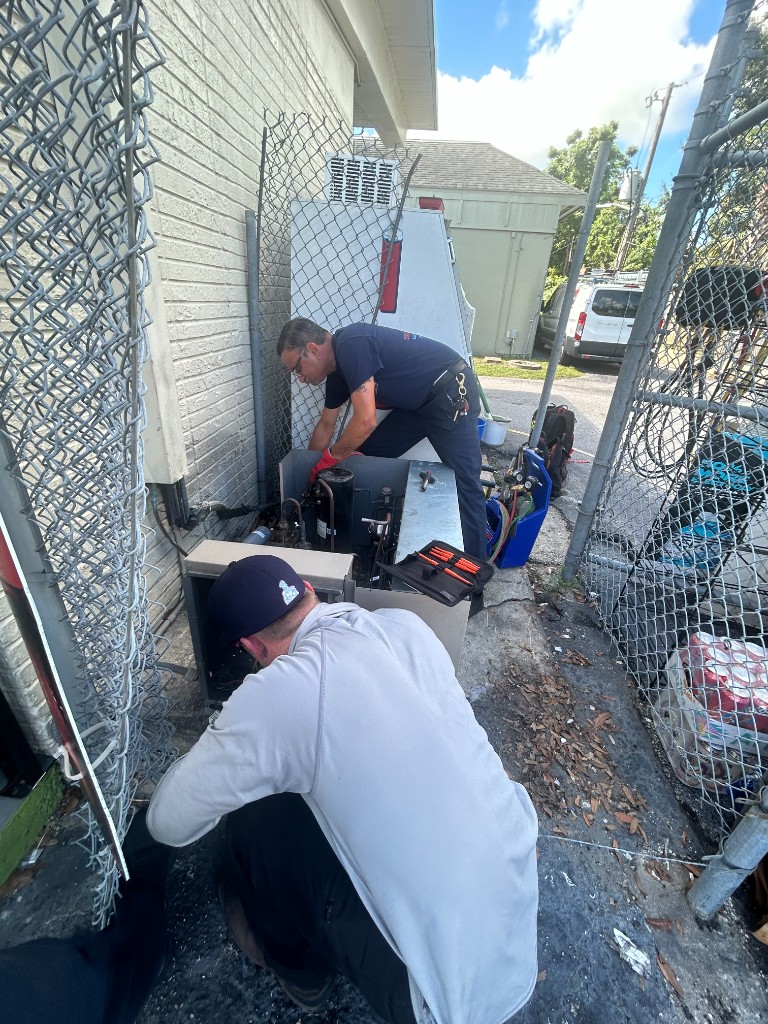

Late-Night Refrigeration Failures: Making the Critical Call
Is your commercial equipment actually breaking down, or is it merely struggling to recover from an intensive dinner service? Deciding between an emergency after-hours repair vs waiting until morning for a failing walk-in freezer is one of the most stressful calls a night manager has to make. It is late at night, the kitchen is finally closed, and the digital temperature display on the walk-in unit is slowly ticking upward. Making the wrong choice carries heavy consequences. If you wait too long, you risk a complete inventory loss. If you panic and demand an immediate dispatch for a non-critical issue, you disrupt operations unnecessarily. If you are facing a critical equipment failure, our team at Integrity Refrigeration & AC provides the professional cooling services you need to protect your business.
This decision becomes especially critical during the busy November holiday prep season. At this time of year, commercial freezers are typically packed to maximum capacity with high-value proteins and prepped ingredients. A failure now does not just mean losing a few boxes of product; it means jeopardizing the menu for the busiest weeks of the year. However, panic should never drive operational decisions. Instead of guessing, restaurant operators need an objective, risk-management approach based on verifiable temperature drop rates, equipment symptoms, and basic thermodynamics.
The goal is to remove the emotion from the situation. By evaluating specific criteria—such as the exact rate of temperature rise, the status of the mechanical components, and the integrity of the insulated envelope—you can make a confident, data-backed decision on whether to pick up the phone immediately or safely lock the doors until the morning shift arrives.
The 41°F Threshold: Understanding the FDA Food Safety Danger Zone
When assessing a failing refrigeration unit, objective safety standards must dictate your timeline. The single most important metric to monitor is the 41°F (FDA food safety danger zone threshold). According to the FDA Food Code, cold food storage must be maintained at or below this specific temperature. Once the internal temperature of the stored food crosses this line, bacterial growth accelerates exponentially, turning a mechanical issue into a severe public health liability.
It is crucial to understand the difference between the ambient air temperature inside the walk-in and the actual core temperature of the food. When a freezer stops actively cooling, the air temperature will rise relatively quickly. However, dense frozen goods—like heavy cuts of meat or large tubs of prepared sauces—will hold their core temperature much longer due to their physical properties. The 41°F (FDA food safety danger zone threshold) applies to the internal temperature of the product, not just a fleeting reading of the air near the door.
This objective metric should completely drive the decision-making process. If a unit is failing but the food remains solidly frozen and well below the threshold, you often have a buffer window. If the product is already thawing and approaching the danger zone, immediate action is non-negotiable.
Monitoring the Rate of Temperature Rise
To determine how much time you actually have, you must establish the rate of temperature rise over a defined period. A single temperature reading only tells you where the unit is right now; it does not tell you where it is heading or how fast it will get there.
- Establish a baseline: Note the exact temperature and time on the external digital display.
- Wait and observe: Do not open the door. Wait precisely 30 to 60 minutes and check the display again.
- Calculate the trajectory: A slow creep of one or two degrees per hour suggests a gradual loss of cooling, often allowing time until morning. A rapid spike of five to ten degrees in an hour indicates a catastrophic failure requiring immediate intervention.
- Verify with secondary thermometers: Built-in digital displays can sometimes malfunction or read the temperature of a localized warm spot near the evaporator. Always verify the ambient temperature with a manual secondary thermometer located deeper inside the unit.
How Ambient Kitchen Conditions Accelerate Heat Transfer
A walk-in freezer does not operate in a vacuum. The environment surrounding the insulated box plays a massive role in how quickly the internal temperature will rise during a mechanical failure. Ambient heat transfer occurs when the warmer air outside the freezer attempts to equalize with the colder air inside, pushing thermal energy through the walls, ceiling, and door seals.
In many commercial kitchens, poor ventilation traps residual cooking heat long after the stoves are turned off. If the ambient temperature of the kitchen remains high, the rate of heat transfer into the failing freezer increases significantly. This is especially problematic when factoring in regional climate variables. In our experience servicing commercial kitchens across Winter Haven and Central Florida, our team at Integrity Refrigeration & AC consistently sees how Florida's persistent high nighttime humidity and warm ambient temperatures prevent commercial kitchens from naturally cooling down overnight. Because water vapor holds latent heat, high humidity acts as a highly efficient carrier of thermal energy, accelerating heat transfer into a failing freezer much faster than dry air would.
If the kitchen air is hot and heavy with moisture, the freezer's insulation must work twice as hard to resist the temperature exchange. Furthermore, if the freezer's mechanical components are still running but struggling to keep up, drawing in hot, humid air forces the compressor to work continuously without cycling off, leading to severe overheating. Understanding the surrounding environment is a critical step in troubleshooting. If you suspect a total loss of power rather than just a cooling failure, determining the first thing to check when a walk-in cooler loses power can help isolate the root cause before dispatching a technician.
Comparing the Risks: Immediate Dispatch vs. Morning Service
When standing in front of a struggling walk-in unit at midnight, the night manager must weigh two distinct paths. Both options carry operational risks, and evaluating them side-by-side helps clarify the best course of action based on the specific symptoms of the equipment.
| Decision Factor | Immediate After-Hours Dispatch | Waiting for Scheduled Morning Service |
|---|---|---|
| Operational Disruption | Requires staff to remain on-site late into the night to facilitate access and oversee the repair process. | Allows staff to close the kitchen on time, but requires the morning crew to manage the repair during prep hours. |
| Inventory Safety | Provides the fastest possible intervention to prevent product from reaching the 41°F (FDA food safety danger zone threshold). | Relies entirely on the thermal mass of the frozen goods and the integrity of the door seals to maintain safe temperatures overnight. |
| Equipment Stress | Allows a technician to safely shut down and diagnose a struggling compressor before it burns out completely from continuous short-cycling. | If left running while failing, a struggling system may suffer extensive mechanical damage; turning it off stops damage but accelerates thawing. |
| Diagnostic Environment | Technicians must diagnose complex electrical or refrigerant issues in the dark or under limited emergency lighting conditions. | Provides optimal lighting, full access to parts supply houses, and standard working conditions for a thorough, permanent repair. |
The comparison above focuses strictly on logistics, food safety, and equipment health. If the freezer is losing temperature rapidly and the inventory is highly sensitive, the disruption of an immediate dispatch is vastly preferable to a total product loss. However, if the temperature rise is minimal and the unit is securely sealed, waiting until morning often results in a more efficient, comprehensive repair process.
The Go/No-Go Assessment Checklist for Night Managers
To remove the guesswork from late-night equipment failures, night managers should rely on a structured, objective evaluation. At Integrity Refrigeration & AC, we offer this honest, transparent risk-assessment framework to prioritize saving our clients' inventory, rather than using high-pressure sales tactics to force a late-night call. Walk through this checklist to determine your next steps.
- Current temperature proximity: Is the internal temperature already approaching the 41°F (FDA food safety danger zone threshold), or is it still safely in the sub-zero range?
- Compressor and fan status: Listen to the equipment. Is the compressor running continuously without taking a break? Is it short-cycling (turning on and off rapidly)? Or is the system completely silent? A silent system indicates a total power or control failure.
- Evaporator coil condition: Look at the fans inside the box. Are they spinning? Is there a massive block of solid ice encasing the coils? Severe ice buildup usually indicates a failed defrost cycle, which severely restricts airflow and cooling capacity.
- Door seal integrity: Inspect the magnetic gaskets around the entire perimeter of the door. A torn or detached seal allows heavy ambient heat to pour into the box. Ensure the latch mechanism engages fully and tightly.
- Inventory volume: Evaluate how much product is currently stored. A freezer packed to the ceiling will hold its temperature significantly longer than a nearly empty unit.
If the checklist reveals a rapid temperature rise, a completely dead system, or compromised door seals, you need to arrange for an after-hours emergency repair immediately to prevent a total loss.

Leveraging Thermal Mass and Door Discipline to Buy Time
If the assessment checklist indicates that the temperature rise is slow and the equipment is not in immediate mechanical danger, you may decide to wait until morning. However, this decision requires strict operational discipline to preserve the cold environment inside the box. The most critical factor working in your favor is thermal mass.
Thermal mass refers to the ability of the stored products to absorb and store cold energy. Solidly frozen goods act like giant ice packs, radiating cold back into the ambient air of the freezer. To leverage this physics principle, you must implement strict procedures.
- Enforce a strict "Do Not Open" policy: Every time the heavy walk-in door opens, dense cold air spills out across the floor, and warm, humid kitchen air rushes in to replace it. Once the decision is made to wait, the door must remain locked and sealed until the technician arrives.
- Monitor externally only: Rely exclusively on the external digital temperature display. Do not open the door "just to check" on the food.
- Utilize temporary cooling measures: If accessible and safe to handle, placing dry ice inside the unit can significantly extend the safe window. Always follow strict safety protocols when handling dry ice in confined spaces, as it displaces oxygen.
- Avoid all DIY repairs: Never attempt to bypass electrical controls, force contactors closed, or modify the refrigerant lines. Modern commercial refrigeration systems operate on high-voltage electricity and pressurized chemicals. Intervening without a license is dangerous and can cause irreparable damage to the system.
Why Density Matters During Holiday Prep
The concept of thermal mass becomes highly relevant during the November holiday prep season. While a breakdown during peak season feels catastrophic due to the sheer volume of product at risk, that peak inventory capacity actually provides a massive buffer against rapid temperature loss. A fully stocked, tightly packed freezer has immense thermal mass. The dense clustering of frozen proteins and heavy liquids retains cold energy far better than the empty air in a half-stocked unit. If the door remains sealed, a fully loaded walk-in can often maintain safe temperatures for several hours longer than a nearly empty one, buying valuable time for a morning service call.
Defining a True Refrigeration Emergency
While thermal mass and tight seals can buy time, certain scenarios leave no room for delay. A true refrigeration emergency occurs when the risk of inventory loss or catastrophic equipment failure becomes imminent. Recognizing these hard triggers ensures you do not hesitate when immediate action is required.
The most obvious trigger is a rapid, uncontrollable temperature rise. If the internal temperature is climbing by multiple degrees per hour and is on a direct collision course with the 41°F (FDA food safety danger zone threshold), waiting is no longer an option. The product will thaw, and bacterial growth will begin before the morning crew arrives.
Another definitive emergency is a complete power failure localized to the unit, especially if the freezer lacks the thermal mass to sustain itself. If the breaker is tripped and will not reset, or the disconnect box is completely dead, the clock starts ticking immediately. Furthermore, any signs of electrical hazards demand an instant response. If you detect the acrid smell of burning ozone, see scorch marks near the compressor, or witness sparking from the electrical panels, shut off the main power to the unit immediately and call for help. Electrical faults pose a severe fire risk to the entire building.
Finally, physical damage to the insulated envelope constitutes an emergency. If a forklift or heavy cart damages the door track, or the latch mechanism shatters, preventing the door from closing and sealing properly, the freezer cannot retain its temperature. Ambient heat will flood the unit instantly. In these scenarios, securing emergency repair services in Lakeland or your local service area is the only way to protect the inventory.
Frequently Asked Questions About Walk-In Freezer Failures
How long can a walk-in freezer stay cold if it breaks?
A fully stocked walk-in freezer can typically maintain safe temperatures for 12 to 24 hours if the doors remain completely closed and sealed. The exact duration depends heavily on the thermal mass of the stored product, the quality of the insulation, and the ambient temperature of the surrounding kitchen. A nearly empty unit will lose its safe temperature much faster, often within just a few hours.
When is a walk-in freezer failure considered an emergency?
A failure becomes a true emergency when the internal temperature rises rapidly toward the 41°F (FDA food safety danger zone threshold), or when electrical hazards like burning smells or sparking are present. It is also an emergency if the door mechanism is physically broken and cannot be sealed, as ambient heat will immediately flood the unit and thaw the inventory.
At what temperature does frozen food go bad in a walk-in?
According to the FDA Food Code, the critical threshold for cold food storage is 41°F. Once the internal core temperature of the food exceeds this 41°F (FDA food safety danger zone threshold), harmful bacterial growth accelerates rapidly. While food may begin to soften before reaching this point, crossing the 41°F mark is the definitive line for food safety compliance.
How does ambient kitchen temperature affect a broken freezer?
High ambient kitchen temperatures significantly accelerate the rate of heat transfer through the walls and door seals of a broken freezer. If a kitchen remains hot and humid overnight, the warm air forces its way into the insulated box much faster than it would in a cool, well-ventilated environment, drastically reducing the time you have before the food thaws.
Should I turn off a failing commercial freezer or leave it running?
If the compressor is making loud grinding noises, emitting a burning smell, or violently short-cycling (turning on and off every few seconds), it is generally safer to turn the unit off at the breaker to prevent catastrophic mechanical burnout. However, if the fans are running smoothly but simply blowing warm air, leaving it on may still provide some minimal air circulation until a technician can diagnose the specific failure.
Secure Your Inventory with Professional Diagnostics
Navigating a late-night equipment failure does not have to rely on panic or guesswork. By utilizing a clear, non-financial checklist focused on temperature rise rates, door seal integrity, and ambient conditions, night managers can confidently make a go/no-go decision. Understanding the physical principles of thermal mass and respecting the strict boundaries of the FDA safety guidelines empowers your team to protect the business.
Whether your assessment points to a late-night emergency during the hectic November holiday prep season, or suggests you can safely wait for a scheduled morning diagnostic, the ultimate goal remains the same: protecting your valuable inventory and ensuring operational continuity. When the situation demands immediate, expert intervention, do not leave your product at risk. Reach out to our professional team at Integrity Refrigeration & AC to schedule an emergency repair in Winter Haven and secure your walk-in freezer today.